Home » 2016
Yearly Archives: 2016

My Encounter with Dr. Matthia Langone: An Advent Reflection
In August 2015 I was invited to deliver three keynote presentations at the National Catholic Women’s League Convention in Vancouver, British Columbia. This event has been the highlight of my professional career, being surrounded by almost 1,000 women of faith whose personal witness to resilience and hope for the Church in Canada is an inspiration for all Catholic women. The theme for the convention was “One Heart One Voice One Mission.” The CWL executive chose an icon written by Dr. Matthia Langone, “The Recognition” to be used by the prayer companions of the Catholic Women’s League during the two-year term of Past President, Barbara Dowding.

“The Recognition” Matthia Langone, 2013.
I was blessed to see and “read” the original print as it was on display during the national convention. Having a great devotion to Mary, I was immediately drawn to the beauty of the icon and the great intimacy expressed in the embrace of Mary and Elizabeth, showing how their encounter was anointed by the Holy Spirit. This mutual “recognition” of the presence of the Spirit in the other and in their children reminds us of the great joy we experience when we encounter a person filled with the Holy Spirit. Their presence feeds us, consoles us and reassures us that we are known with a great intimacy. There is a familiar resemblance among those who are filled and led by the Spirit. I am blessed to have encountered so many Spirit filled women whom I call friends and sisters. Dr. Langone is among them.
Soon after admiring the original of “The Recognition” I noticed the author/painter, Dr. Matthia Langone, was present selling prints and gift cards. I rushed over to her display table and purchased a print of the Recognition. I told her how much I loved the icon and how my devotion to Mary and her intercessory prayers have sustained me throughout the years. Several months after the convention I emailed her to order more prints so that they could be given as gifts. Our email correspondence grew into a long distance friendship, writing short messages of encouragement and reassuring one another of prayer and mutual admiration. We have spoken on the phone once and within ten minutes I concluded I was speaking with a person who knows God very intimately, who understands the deep spiritual insight revealed in the encounter between Mary and Elizabeth, the Visitation. I was experiencing my own “encounter/visitation” with a woman who is filled with the Holy Spirit and knows the power of God’s love revealed in this holy encounter between two of God’s cherished daughters, Mary and Elizabeth. Her insight into the exchange between them, how their words were anointed by the Holy Spirit, how Elizabeth knew Mary with great intimacy, how they encouraged one another, inspiring Mary’s Magnificat, touched me very deeply. Dr. Langone’s icon is a celebration of this encounter, of the power of God’s love and the power of Spirit-filled friendships. Thank you, Matthia for the strength of your witness and for the gift of this icon, a gift I carry with me to show others the fruits of Spirit filled encounters.
Please visit Dr. Langone’s website to see more of her beautiful work and for the purchase of prints: http://www.wayoftheicon.com/blog/painting-to-be-shown-at-national-convention

Women of the Word – Toronto Retreat with Dr. Josephine Lombardi
Guest Blog Post by Mary Filangi – Women of the Word
We had an amazing day with 191 women and 3 priests together for the same reason. Hope, Healing and Restoration. Our Goal at Women of the Word is to provide a bridge for all women in all walks of life where Our Lady can guide us and Our Lord can heal and restore us.
Dr. Josephine Lombardi knows this in the depth of her soul and God has blessed her with the extraordinary gift of being able to speak with beautiful simplicity and clarity; the language of love and healing.
One of the priests yesterday sent me a text “So many deep sublime confessions. A lot of it comes from the insightful talks of Dr. Lombardi. She’s so special” And Josie herself always points the finger away from herself and towards heaven, saying “it is God’s Grace”. It was an awe inspiring day with insightful genuine talks, confession, sharing, dancing, food, ending with a meditative Rosary, Consecration to Our Heavenly Mother and the Celebration of Holy Mass with Fr. Peter Choi.
As one woman said as she was leaving, “I’m so full, I’m going home to share what I’ve received”!
For more information on Woman of the Word please go to www.wowblessingstoronto.com


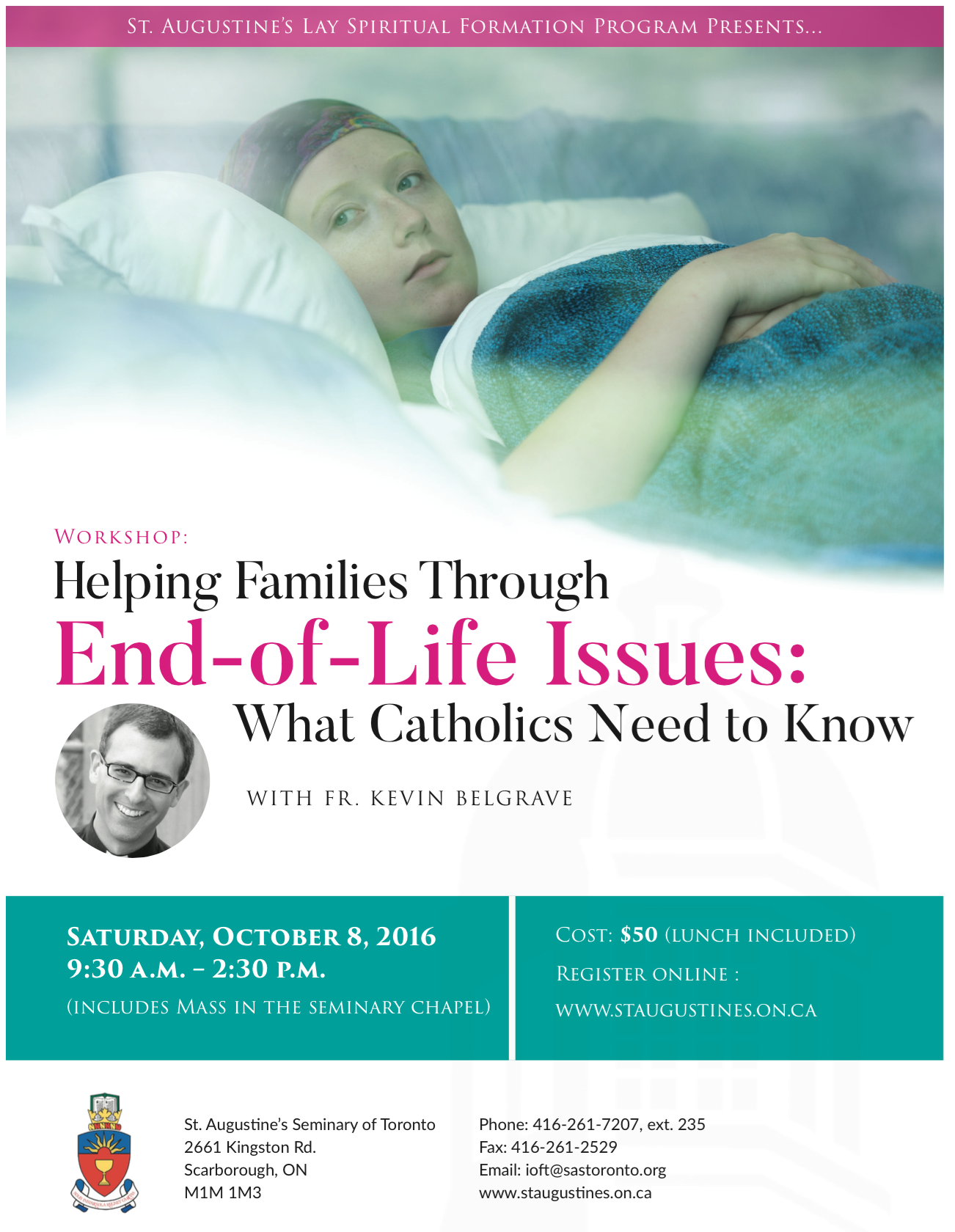
Workshop with Fr. Kevin Belgrave: Helping Families Through End-of-Life Issues
Join Fr. Kevin Belgrave at St. Augustine’s Seminary on Saturday October 8 for this important workshop. Please see poster online for full details on how to register online.

A Day of Reflection for Women: Saturday, June 4, 2016
Dear Friends of the Institute of Theology,
St. Augustine’s Institute of Theology invites you to participate in A Day of Reflection for Women:
Date: Saturday, June 4, 2016
Time: 10:00 a.m. to 4:00 p.m.
Topic: “Knowing God’s Perfect Love Is Knowing God’s Mercy with Dr. Josephine “
Dr. Lombardi will explore obstacles to loving God, oneself and others. There will be time for private reflection and small group sharing, lunch and Mass.
Read the flyer for more details. Registration for this Lay Formation event is open. You can pay and register here.
If you have questions regarding the event, please e-mail tat.mukhina@utoronto.ca or call 416-261-7207 ext. 235.
Bring your mothers, sisters, daughters and friends!


Cardinal Thomas Collins met with media Friday as Pope Francis releases papal document on the family
On Friday, April 8, 2016, the Vatican released Pope Francis’ Apostolic Exhortation (papal document to the global church), “Amoris Laetitia: On Love in the Family”, bringing together the results of two recent Synods on the family convoked by the Holy Father in 2014 and 2015. To help provide context to this important document and recognizing the many pastoral challenges facing the family today, Cardinal Thomas Collins, Archbishop of Toronto, and a panel (including theologians and a married couple) met with the media to answer questions and offer brief reflections on Amoris Laetitia (WATCH VIDEO below):
Dr. Moira McQueen – Moral Theologian and Executive Director of the Canadian Catholic Bioethics Institute, Dr. McQueen participated in the 2015 Synod on the Family in Rome.
Dr. Josephine Lombardi – Associate Professor of Pastoral and Systematic Theology at St. Augustine’s Seminary, Dr. Lombardi has many years of pastoral experience working in parishes and schools.
Randy & Anna Boyagoda – Dr. Randy Boyagoda is a professor at Ryerson University and writes frequently about religion, politics, and culture. Dr. Anna Boyagoda directs the Catechesis of the Good Shepherd program for the Archdiocese of Toronto. Randy & Anna have four children, ages 3-10.
Additional resources can be found at: http://www.archtoronto.org/synod
Paschal Triduum: the three days of Passover
Source: Living with the Liturgical Year by Josephine Lombardi
The term “Paschal Triduum” means “the three days of Passover.” Passover commemorates God’s deliverance of the people of Israel from slavery. These days are the heart of the liturgical year.
Holy Thursday: The Call to Serve
Holy Thursday is a special day when we recall
- the Institution of the Holy Eucharist (the Last Supper),
- Jesus washing the feet of his disciples, and
- the institution of the priesthood.
 Holy Thursday establishes us as a eucharistic people and as people of service. Jesus came as one who serves. His humility was overflowing. After he washes the feet of his disciples, he says, “So if I, your Lord and Teacher, have washed your feet, you also ought to wash one another’s feet. For I have set you an example, that you also should do as I have done to you” (John 13:14-15). Just as he did at his baptism, Jesus shows us how it’s done. God honours humility. God blesses humility. This is a radical idea! If everyone lived with humility, family life would change, the workplace would change, school would change, marriage would change, society would change. Those who are called to leadership or supervisory roles are called to acts of humble service and love of neighbour.
Like Passion (Palm) Sunday, however, Holy Thursday presents us with another bittersweet revelation: on the night that Jesus celebrates the Last Supper with his friends, one of them betrays him.
Many of us can relate to this scenario:
- The day we get a new job, we hear that a loved one has been diagnosed with cancer.
- Two years into a marriage, a spouse passes away.
- Three months into a pregnancy, a miscarriage occurs.
- Fifteen years into a marriage, a spouse decides to leave.
- Weeks after graduation, a beloved child dies in a car accident.
The list can go on and on. We may be living the paschal mystery in our daily lives without making the connections. As Jesus relates to our bittersweet seasons, we relate to his.
Good Friday: Spiritual Drought
 Good Friday is a painful day as we meditate on the events leading up to the death of our Lord. It is not unusual for Christians to place themselves at the scene. Do we relate to the crowd? To the women? To Mary, Jesus’ mother? To his apostles? To Jesus himself?
Many who have experienced the loss of a loved one find themselves relating to Mary and to the many others who loved Jesus. Grief can be lonely and isolating. The waves of grief come and go and can leave us paralyzed from time to time. The good news, however, is that Jesus conquered death: the loss of our loved ones is temporary. We have the promise that we will see them again. When Martha is grieving the passing of Lazarus, Jesus says: “Your brother will rise again …. Those who believe in me, even though they die, will live, and everyone who lives and believes in me will never die” (John 11:23-26). Similarly, St. Paul discourages us from grieving, as those who have no hope do (1 Thess. 4:13). The separation we experience is not forever. Our pain is healed; our hope is restored.
While we honour Good Friday in the present, we live it within the reality of the paschal mystery: Jesus died, Jesus rose from the dead and Jesus will come again. This mystery consoles us in times of grief and reminds us that God can and will redeem our losses. We participate in the fullness of the paschal mystery.
Good Friday reminds us that Jesus was victorious in the end. Through his death, Jesus conquers death, darkness and sin. Sometimes God can use what we perceive as a setback or a disappointment to bring a greater good. God can redeem all of our losses and disappointments with renewed strength, insights and emotional healing. The key is to keep our eyes fixed on Jesus Christ and his truth.
Holy Saturday: Light that Overcomes Darkness
 The early Church celebrated the night before Easter by illuminating the churches and even entire cities. Services started around three in the afternoon and ended with the Mass of the Resurrection on Easter morning. At the Easter Vigil we celebrate this ancient rite. On this day, we reflect on the time Christ remained in the tomb, his descent to the dead, and his resurrection. The Easter Vigil fills us with hope and expectation as it inspires us to stop and reflect on the great gift of the paschal mystery. We die and rise with Christ in the past, present and future as we wait at the empty tomb with wonder and awe. We are reminded that Jesus Christ is the same yesterday, today and tomorrow (Hebrews 13:8). Holy Saturday is a good time to reflect on how well we wait on the Lord. Are we too busy and distracted to see him among us? Do we place value on unimportant things rather than on our loved ones?
Holy Saturday challenges us to be like Mary, who chose the better part (Lk. 10:42). Waiting for prayers to be answered, lives and relationships to be restored, requires trust and rest in the Lord. Jesus waited for the resurrection. God’s timing is the best timing. Are we mindful of those times we are called to be still and wait?
Easter Season
Easter Sunday is the feast of feasts, the solemnity of solemnities. It is, writes St. Athanasius, the Great Sunday. Easter Season begins on Easter Sunday and ends with Evening Prayer on the Solemnity of Pentecost. The Church teaches “The fifty days from Easter Sunday to Pentecost are celebrated in joyful exultation as on a feast day, or better as on ‘Great Sunday.’” (General Norms for the Liturgical Year, #22)
Easter is the reason for the liturgical season and for the spiritual journey. Easter is a reminder that
- the resurrection of Jesus really happened;
- we, too, will be resurrected and receive a glorified body;
- death, darkness and sin have been conquered once and for all;
- we can be made new, despite our pain and loss;
- truth prevails;
- brokenness is healed;
- creation is restored;
- eternal life with God is possible.
Easter is the season of restoration, healing and reconciliation.
I hope God showers you and your family with graces this Holy Week,
Josephine